Sustainability
Sustainable Properties
Sustainable Properties

The Group’s Environmental Management System (EMS), aims at reducing the environmental impact of our assets at every stage of their life cycle, from initial design to daily operation as well as future fungibility.
The Group has defined and monitors several indicators to manage the environmental performance of its standing assets and development projects, in line with the objectives of our ESG strategy.
VGP, through the implementation of its environmental management system and sustainability guidelines, ensures that all development projects are designed in accordance with the Group’s sustainability strategy in order to manage their environmental impact.
For each project, the EMS covers all 4 stages of the development process and involves several departments, notably Technical, Sustainable Buildings, Commercial, Facility Management and the local project management team:
Sustainability and risks related to climate change are analysed and evaluated during the Group’s due diligence process.
At key milestones during the design of the project, the latter is assessed using the Group’s Sustainability Brief to ensure compliance with the Group’s sustainability strategy
The project management contractor and or sub-contractors agree to abide by the Group’s Considerate Construction Charter, which is designed to limit the social and environmental effects of the construction process.
A commissioning process is followed to ensure that buildings’ technical installations perform efficiently (settings and operating instructions), and that maintenance suppliers in charge of operations and running technical installations as well as properly handed over to the facility management teams.
Logistics and semi-industrial sites use natural resources for construction and facilities. The current logistics real estate sector follows a linear “take-make-waste” model, but VGP aims to change this. VGP has adopted a Carbon Pricing and Circular Economy Framework to guide development teams in integrating circular economy solutions. This framework helps teams choose the right circular economy solutions for their projects. VGP is committed to reducing its construction carbon footprint by 20% between 2020 and 2030, focusing on material choices.
The Group Carbon Pricing Circular Economy Framework aims at integrating circular economy concepts in the design of VGP’s development projects. Circular economy requirements are part of the sustainability guidelines for the development projects and in this context all development projects can assess the impact of inclusion of circular economy concepts from the framework into the design, selecting the ones that will make the most sense for each development project.
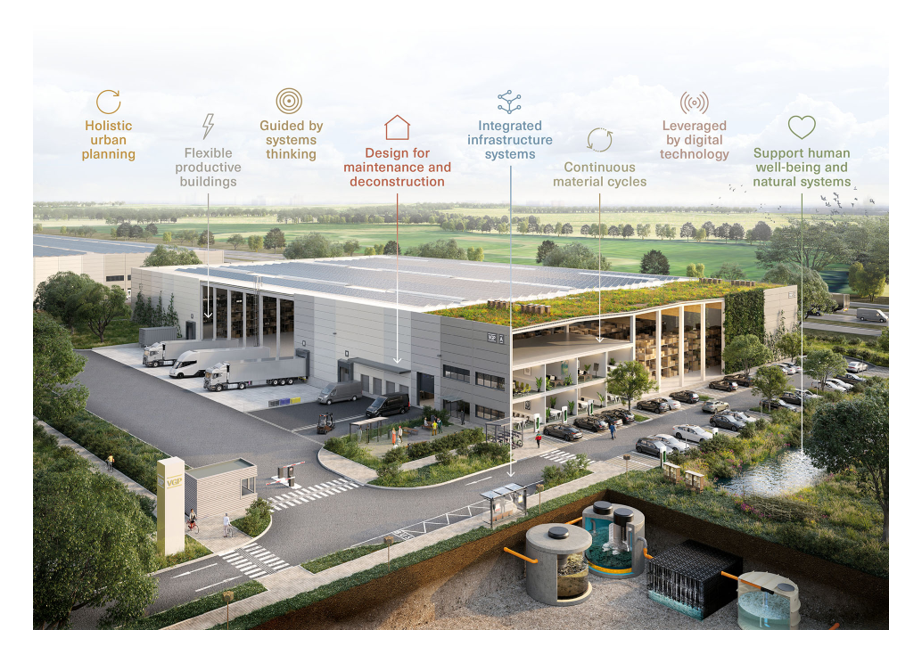
The Group has set a target to process at least 70% of non-hazardous construction and demolition waste for reuse, recycling, or recovery, in line with EU Taxonomy requirements. This involves strict waste monitoring and implementing best practices to eliminate waste, keep materials in use, and reduce primary material consumption.
Updated sustainability guidelines were introduced for new developments, extensions, and renovations. Key requirements include:
Specific actions include adopting lean material construction, using low-carbon materials, encouraging subcontractors to propose low-carbon solutions, and implementing a purchasing policy with carbon content criteria.
VGP’s procurement strategy aims to ensure: fairness, focus on quality, long-term partnerships, reduced risk and the respect for applicable regulations.
VGP was recognized by CDP in the Leadership band for “implementing current best practices” in terms of its supplier engagement.

VGP Park Rouen in Petit-Couronne, France, is a flagship example of VGP’s approach to integrating circular economy principles into industrial real estate. Constructed on a former industrial brownfield site, the project demonstrates how sustainable redevelopment can contribute to resource efficiency, waste reduction, and long-term value creation.
Rather than consuming new land, VGP Park Rouen was built on a repurposed industrial site, avoiding urban sprawl and reducing the environmental footprint. This approach aligns with EU Taxonomy goals for sustainable land use and contributes to the regeneration of underutilized assets.

A 2.5 MWp solar photovoltaic plant, currently being installed, will provide renewable energy to power the facility. The expected generation capacity is equivalent to the consumption of over 1,000 households.
The project integrates restoration of biodiversity, including 144 new trees planted, enhancing carbon sequestration, 9,000 sqm of wildflower meadows, fostering local biodiversity and habitat creation for wildlife, including hibernaculums, reinforcing ecological resilience.
VGP Park Rouen is designed with future adaptability in mind, embedding circular economy thinking into its long-term functionality including scalable office spaces and modular extensions allow for easy repurposing and reduced demand for raw materials over the building’s lifecycle.